Thursday, June 23, 2011

Zosma Appeared at Japan

Still remember codename Zosma? It is a new Phenom II quad-core processor line based on the same six-core Thuban silicon, but with two cores disabled. Beside the two "potentially" unlockable cores, Zosma also brought the AMD's Turbo Core technology, which previously only found on Six Core Phenom II.

Phenom II X4 960T Black Edition "Zosma" recently spotted at Japan market. This quad-core chip with unlocked multipler comes with the part number HD96ZTWFK4DGR, and is sold in PIB (processor in a box) packages. The chip was tested to allow unlocking of the disabled fifth and sixth cores, proving it's based on the Zosma silicon. It comes with a stock clock speed of 3.00 GHz (15 x 200 MHz), but can bump clock speeds up to 3.40 GHz (17 x 200 MHz). The chip features 512 KB of L2 cache per core, and 6 MB of shared L3 cache.

Tuesday, June 14, 2011

Mobile A-series Llano finally launches

AMD has launched seven mobile parts of A-series "Llano" Fusion APU today, and the desktop models have yet to make an official appearance soon.


AMD is making some bold claims, in terms of battery life where the company is promising up to 10.5h of usable battery life. In fact, AMD claims that its A8-3510MX APU has 3.5h better battery life than a similar notebook with Intel's Core i5-2410M processor.


When it comes to graphics performance, AMD has always had a huge lead here over Intel, but AMD has thrown in a few new features that should further boost the appeal of its APUs. First up AMD has added what the company called Perfect Picture HD which is a post-processing option for cleaning up 1080p video, a feature that might prove popular with people shooting their own HD home videos. The second feature, called Steady Video is rather quite impressive, it actually pre and post processes the video to reduce camera shake and it even works with online videos.

As always, AMD is being very competitive on price and the company is expect notebook with its new APU's to start at US$499 with an A4 APU, whereas with an A6 we're looking at around US$599 and finally A8 models will come in at around US$699. Of course these are best case scenarios and we'd expect a lot more expensive machine to be available as well, depending on configuration. For those looking for a boost to the graphics performance beyond the APU's integrated solution, AMD supports CrossFire on the platform and claim up to a 75 percent performance boost for its discrete mobile GPUs when pairing them up with an APU.

Thursday, June 2, 2011

AMD Confirms Delay of Bulldozer

During the company's press conference dedicated to the launch of AMD 9-series core-logic sets, AMD announced that its long-awaited FX-series microprocessors will be available within the next 60 to 90 days from now, which points to August or September. Mainboards based on the new AMD 9-series chipsets with AM3+ socket will support both existing high-performance multi-core Phenom II microprocessors as well as AMD FX-series chips with up to eight cores.


Below is official rendered image of AMD 8-Core FX Processor Black Edition box (PIB):

Tuesday, May 31, 2011

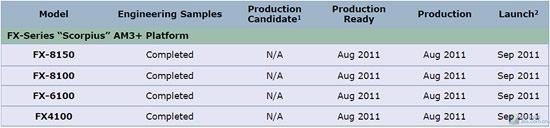
Bulldozer Maybe Delayed and Need More Tuning

Advanced Micro Devices may further delay release of its highly-anticipated FX-series microprocessors code-named Zambezi that are based on the Bulldozer micro-architecture, according to leaked slides published by a Chinese web-site.


The slides also point to new model numbers for the chips: FX-8150, FX-8100, FX-6100 and FX-4100, which may indicate that the company intends to alter previously set specifications of the chips.

Earlier it was believed that AMD would launch its FX-series of chips in June, 2011. It was also reported that the highest-performing eight-core offering would cost $320, which is in line with the top-of-the-range Core i-series "Sandy Bridge" CPU.

The long-awaited CPUs are now fully-functional and work without flaws, according to a person who wished to remain anonymous. The problem with the delay of the AMD FX family of chips is that they currently cannot operate at truly high-speeds and thus cannot achieve performance levels that AMD wanted them to. As result, AMD will need to design a new stepping of the processor and therefore delay the commercial launch to September.

The currently available B0 and B1 stepping Zambezi/Bulldozer processors can function at around 2.50GHz/3.50GHz (nominal/turbo) clock-speeds and at such frequency they cannot deliver performance AMD considers competitive, a person with knowledge of the situation said on Monday. As a consequence, AMD needs to tune the design of the processor and create B2 stepping of the chip with better clock-speed potential amid similar thermal design power (TDP), which will take several months to complete.

This will slowdown revenue growth of the chip-maker and will also hit its reputation, as this is by far not the first or second delay of Bulldozer in general and Zambezi in particular.

Sunday, May 29, 2011

Llano Competitive Positioning

According to some new leaked slides, systems based on AMD's top-of-the-line, A8-series Llano APUs will in fact compete against those based on higher-end Core i5 and lower-end Core i7 processors, with prices of $699 and upward. A6-series Llano chips look set to go against higher-end Core i3s and lower-end Core i5s, while the A4 series will seemingly tackle the lower end of the Core i3 family.


More shocking still, the slide suggests that PCs based on AMD's next-generation E-series processors—Zacate's successor—will compete dollar-for-dollar with systems based on Intel's Pentium processors. However, the slides are dated May 17, which predates the introduction of Intel's new Sandy Bridge-based Pentiums.

Friday, May 27, 2011

AMD's Llano APUs Expected to be Affordable

Desktop versions of Fusion - Llano accelerated processing units (APUs) by Advanced Micro Devices are likely to be rather inexpensive, which may make them popular among PC builders as well as end-users. According to media reports, the new desktop chips will cost starting from $70.

The initial family of AMD A-series "Llano" APUs will include five chips and beside that, AMD will also offer a low-end E2-series solution featuring Llano design. The most affordable solution in FM1 form-factor will cost $70 (E2-3250), whereas the most powerful A-series chip will be priced at $170 (A8-3550P).


AMD A-series desktop APUs will have either four K10.5+/Husky x86 cores as well as Radeon HD 6000-class "BeaverCreek" (320 or 400 stream processors) graphics core or two x86 cores and "WinterPark" (160 stream processors) integrated graphics engine. The chips will support dual-channel DDR3 memory controllers, up to 4MB of cache, select processors may also feature AMD Turbo Core dynamic acceleration technology as well as a special multi-GPU graphics support.

AMD A8- and A6-series APUs set to compete against Intel Core i3-2100-series microprocessors, whereas the A4- and E2-series chips will rival Pentium and Celeron solutions.

Wednesday, May 25, 2011

MSI WindPad 110W


MSI's WindPad 110W slate has appeared at ExcaliberPC online store, where it's listed with a June 1st arrival date and a $599 price tag. This new 10.1-inch device runs Windows 7 Home Premium and is based on AMD's Brazos platform.

The WindPad 110W has an 1280 x 800 touchscreen, an E-350 APU (two x86 core @ 1.6 GHz, Radeon HD 6310 DX11 graphics), 2GB of RAM, a 32GB SSD, an SD card slot, 802.11 b/g/n WiFi, Bluetooth 3.0, a webcam, USB 2.0 and mini HDMI ports, and a 4200 mAh battery.